No-deferral rule
Never Let Me GoThe No-deferral rule is the denial of a rumored reprieve from the students’ prescribed donations: love between a couple could not earn them extra time. When Miss Emily confirms this to Kathy and Tommy at Madame’s house, she makes clear that the promised exception was never available, even during Hailsham’s most influential years. The rule is more than a correction of hearsay. It exposes the boundary between the humane conditions Hailsham sought to secure and the fate its students could not escape.
The Rumor and Its Repetition
The rumor had circulated long before Kathy and Tommy sought an answer. Miss Emily recalls that, while Hailsham still existed, two or three couples would come to speak with her and Madame each year; one couple even wrote. A large estate could be found by students determined to break the rules, so the repeated visits made the belief difficult to dismiss as a private fantasy. The rumor outlasted any one group of students or any particular attempt to stamp it out.
Miss Emily says she had tried to suppress talk of deferrals within Hailsham. But she came to think the rumor was recreated from scratch wherever students encountered the same uncertainty. Madame’s view, as Miss Emily reports it, was to let students believe what they wished. Miss Emily eventually reached a different, though still uneasy, position: she thought it might do little harm as a dream, since most students would never test it. That distinction collapses when Kathy and Tommy arrive. They are not asking out of casual curiosity; they have hoped carefully and come to pursue the possibility seriously. Miss Emily recognizes that, for them, allowing the fantasy to persist has a cost.
Kathy and Tommy Receive the Answer
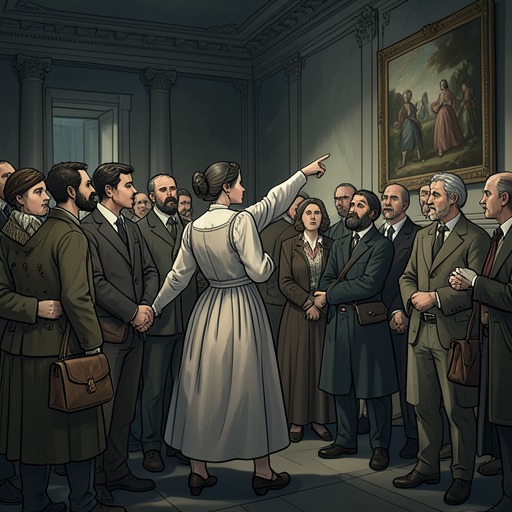
At Madame’s house, Kathy asks directly whether deferrals exist and whether anything can be done. Miss Emily answers that there is no truth in the rumor. Tommy then presses the question backward in time, asking whether the arrangement might once have been real, before Hailsham closed. Miss Emily denies that too: the supposed exception had never existed, not even before the Morningdale incident, when Hailsham was regarded as a model of more humane treatment. She describes it as wishful rumor, not a lost policy that the couple might recover.
The exchange closes off successive forms of hope. The rumor cannot be treated as a rule that applied to earlier students, a privilege lost when Hailsham closed, or a decision still available to the adults the couple has approached. When Tommy asks again whether there is definitely nothing, Miss Emily gently confirms that there is no deferral and that his life must follow the course set for it. Her answer gives the couple no alternative procedure, appeal, or exception to pursue. It changes their visit from a search for permission into a confrontation with the limits of what permission can do.
What Hailsham Could and Could Not Change
Miss Emily places the false rumor beside Hailsham’s real achievements. She says that Hailsham and Glenmorgan House were the first establishments of their kind, followed by the Saunders Trust. Together, they formed a vocal movement that challenged the way the Donation Programme was run. They collected and exhibited students’ art to demonstrate that students raised in humane, cultivated surroundings could be as sensitive and intelligent as ordinary people. In the late seventies, when the movement was at its height, its public events drew prominent attendees and pledges of support.
That advocacy secured improvements, but not the power to suspend donations. Miss Emily insists that even at the height of its influence, Hailsham could never have granted the couple’s imagined reprieve. The contrast matters: the school could provide an education, cultivated surroundings, and protection from the worst conditions faced by students elsewhere, while leaving the central demand that students donate intact. After the Morningdale incident and other setbacks, support for the movement ebbed and Hailsham and its allies were swept away. Yet the denial of deferrals does not depend on that decline; Miss Emily says the exception was never real even before it.
She also explains why humane reform faced such limits. After the war, rapid scientific breakthroughs made new cures possible, and people focused on the benefits rather than the lives of those whose organs supplied them. Once society had come to regard those cures as necessary, Miss Emily argues, there was no going back. Students were kept in the shadows and treated as less than human, while Hailsham’s campaign tried to make their humanity visible without overturning the system that required their donations. The No-deferral rule is the most personal expression of that impasse: recognition and better treatment did not amount to control over their futures.
Personal Consequences and Narrative Significance
For Kathy and Tommy, the rumor had made love seem capable of changing the timetable imposed on them. Miss Emily’s answer separates the reality of their relationship from the imagined power attached to it. She does not deny their seriousness or the care with which they have hoped; she regrets that she must disappoint them. But sympathy cannot become an exception to the rule. The couple’s affection can matter deeply to them without altering the course of their lives.
The revelation also casts earlier choices of care in a sharper light. Kathy says that choosing donors from her past allowed her to become close again to Ruth and Tommy after years apart. When Ruth, after her second donation, is gravely ill and only briefly lucid, Kathy promises that she will become Tommy’s carer. Ruth had given Tommy the paper with Madame’s address so that he could try; Kathy’s promise is another act of personal care, not a means of changing the donation system. Later, Tommy asks Kathy whether she ever wishes they would send her notice to stop caring and make her a donor. His question underscores the imbalance: donors will donate and complete, while the work of caring offers no exemption from that end.
The rule therefore connects private devotion to institutional power without treating them as equivalent. At Hailsham, students’ creative work could support a public argument for their humanity; within the students’ own community, Exchanges also made possessions and creative ability part of social life. But neither art, affection, nor the adults’ regret could secure the deferral the couple sought. Kathy’s observation that a passing trend may be historical for others but is their life gives the denial its full weight. The rumor survives because it offers a possibility the institution cannot provide; its exposure leaves love intact, but strips away the belief that love can postpone what comes next.